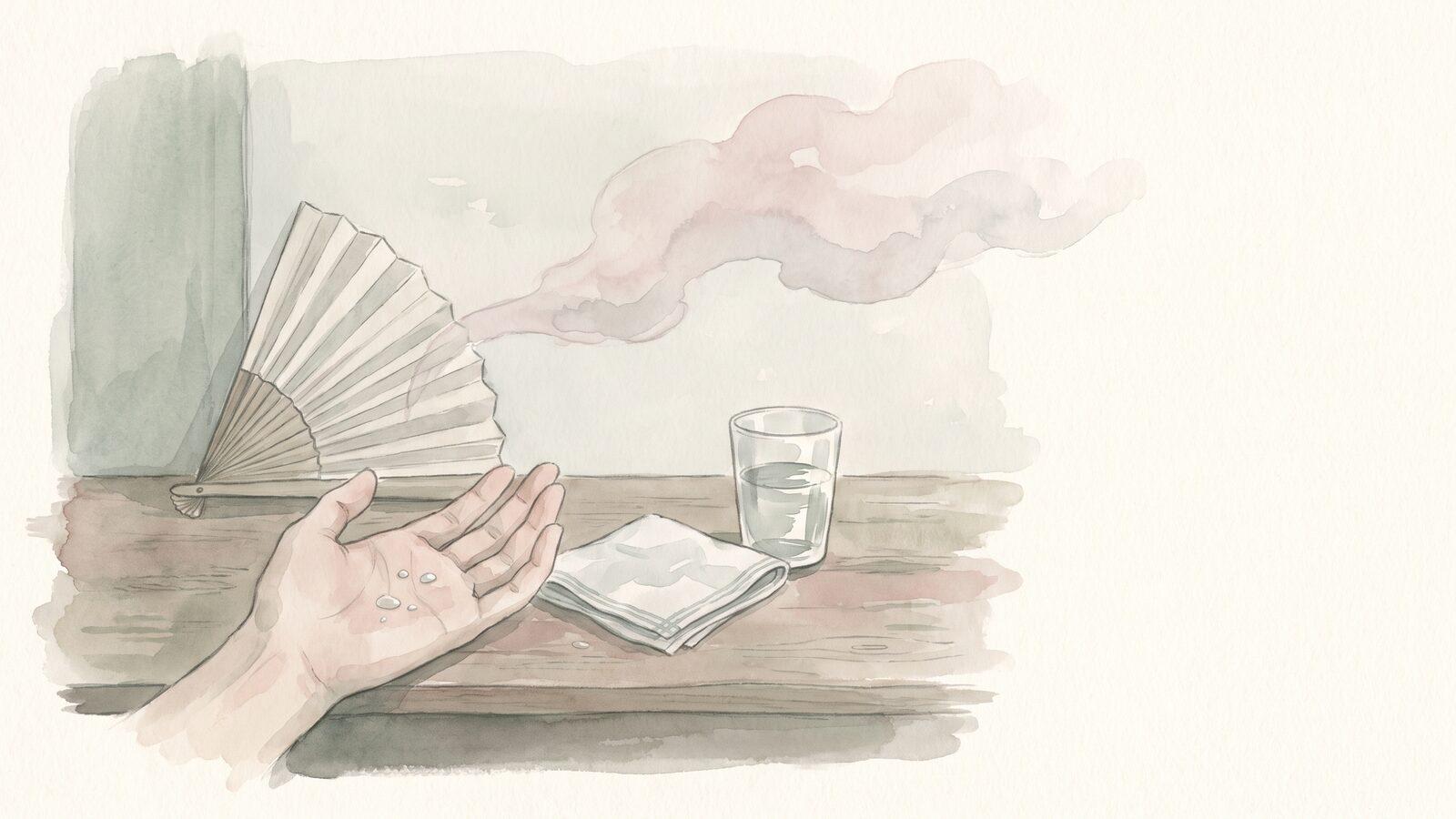
The meeting has not started yet. The room is cool, and your shirt is already sticking to your back. Your palms are damp enough that you wipe them on your trousers before the handshake, then wonder whether the other person noticed. Maybe it happens at night too: you wake up with damp sheets and a pounding heart and lie there wondering whether something is wrong.
Sweating is a common physical symptom of anxiety, and a frustrating one, because the sweat itself quickly becomes something new to worry about. This guide covers why stress makes you sweat, how to tell it apart from hyperhidrosis and other causes, what helps in the moment and over time, and when to ask a doctor. One honest note: the pattern of your sweating can point you in a direction, but it cannot diagnose the cause on its own.
Why Anxiety Makes You Sweat
Sweating is part of the same stress response behind the other physical symptoms of anxiety. When your brain reads a situation as a threat, real or imagined, the sympathetic nervous system switches on, adrenaline rises, and your body prepares to act: a faster heartbeat, quicker breathing, tense muscles, and, for many people, sweat glands that start working within moments. In some people that rise in heat and sweat also brings out small itchy bumps, a form of stress and heat hives.
This is often called emotional or stress sweating, to set it apart from the sweating that cools you on a hot day. It tends to show up on the palms, the soles of the feet, the underarms, and the face. That is why it can happen in an air-conditioned room. Your body is not too hot. It is reacting to what is going on in your head.
In a retrospective analysis of social-anxiety treatment trials, excessive sweating was recorded in roughly one-quarter to one-third of 375 participants, depending on the symptom scale, and it went along with greater fear, avoidance, and disability. Those were selected trial participants, so the numbers do not describe everyone with anxiety. They do show you are far from alone.
What Anxiety Sweating Feels Like
- It starts fast. Palms or underarms go damp soon after a stressful thought, sometimes before you have fully noticed it.
- It follows the situation. It rises before a presentation, a phone call, or a difficult conversation, and often eases once the moment passes.
- It lands in familiar places. Hands, feet, underarms, face, and scalp.
- It comes with company. A racing heart, a tight chest, a dry mouth, or a tremor. If you have read about anxiety shaking, the two often arrive together.
- It often feels cold. Many people describe a cold, clammy sweat rather than the flushed heat of exercise.
- It can follow you into the night. Night sweats have several possible causes, so they get their own section below.
Is It Anxiety, Hyperhidrosis, or Something Else?
Excessive sweating has a medical name, hyperhidrosis. The NHS explains that it can happen without a clear reason, because of another condition, or as a side effect of medicine. Anxiety and hyperhidrosis can also coexist.
Primary hyperhidrosis has no underlying cause. According to the American Academy of Dermatology, it usually affects one or two areas, such as the underarms, palms, soles, or face, typically starts at age 24 or younger, and stops while you sleep. People with it often become anxious about their sweating, but the sweating came first and shows up on calm days too.
Secondary hyperhidrosis is caused by something else. The same AAD page notes that it can make you sweat during sleep, and lists medicines (including some antidepressants), diabetes, menopause, and withdrawal from alcohol or other drugs among the causes. An overactive thyroid can also cause excessive sweating, along with heat sensitivity, trembling, a fast heartbeat, weight loss, and, confusingly, nervousness and anxiety.
A rough way to sort what you notice:
| Often fits anxiety | Often fits primary hyperhidrosis | Worth checking for another cause | |
|---|---|---|---|
| Trigger | A stressful situation or thought | None needed; calm days too | Often unrelated to mood |
| Where | Palms, soles, underarms, face | One or two of the same areas | Larger areas or whole body |
| Sleep | May wake you after a stressful day | Usually wake up dry | Sweating during sleep is common |
| Since when | Since the anxiety began | Since childhood or the teens | Since a new medicine or illness |
| Other signs | Racing heart, tension, dread | Usually none | Fever, weight loss, heat intolerance, hot flushes |
Treat the table as a guide for what to tell a clinician, not a test. You do not need to work out which column you belong to before asking for help.
When Sweat Becomes the Worry
For many people the sweating feels worse than the anxiety behind it, because it is visible. A racing heart is private. A damp shirt is not.
That creates a loop. You notice the sweat, worry that others can see it, the worry adds stress, and the stress can bring more sweat. Soon you are thinking about your hands instead of the meeting. Our article on anxiety sensitivity describes this: the body's signal becomes the thing you fear.
People with social anxiety may start avoiding handshakes, light-colored shirts, or crowded rooms. Avoidance brings short-term relief but teaches your brain that sweating really was a disaster, which makes the next time harder.
Two things help. First, people notice far less than it feels like: in experiments on the spotlight effect, participants consistently overestimated how much others noticed their appearance and actions. Second, treat the sweat as a symptom you can manage, not a verdict, and bring your attention back to the conversation.
How to Reduce Anxiety Sweating in the Moment
- Cool down. Run cold water over your wrists, hold a cold drink, step outside, or take off a layer.
- Slow your exhale. Two short inhales through the nose and one long exhale through the mouth, a few times, is the physiological sigh. It can help you feel calmer, though it does not promise an instant stop to sweating.
- Stop fighting it. Clamping your arms to your sides adds tension and heat. Let your shoulders drop.
- Name it once. Silently: "This is adrenaline. It usually passes." Then return to the room instead of checking your palms.
- Bring what you need. A tissue, a cold water bottle, a darker top on a hard day, a spare shirt. Preparation answers the "what if I sweat" question so you can focus on what is happening.
If an episode comes with severe chest pain, fainting, or other alarming symptoms, get urgent medical care rather than assuming it is anxiety.
What Helps Over Time
Use antiperspirant at night. Many people apply it in the morning to skin that is already damp. The American Academy of Dermatology advises applying it to dry skin before bedtime. A pharmacist can suggest stronger non-prescription products, and the AAD notes that many people with hyperhidrosis need a prescription antiperspirant.
Choose clothes that help. The NHS recommends loose-fitting clothes and avoiding tight or synthetic fabrics. Sweat shields protect clothing, and darker or patterned colors hide damp patches.
Cut back on your own triggers. The NHS suggests avoiding triggers such as alcohol and spicy food. Caffeine can make anxiety symptoms feel stronger for some people; our guide to how much caffeine is too much helps you find your threshold.
Face what you have started avoiding. Deliberately doing the handshake, wearing the grey shirt, and staying in the meeting while the sweat happens teaches your brain it is uncomfortable rather than dangerous. Step by step works better than the deep end. Exposure therapy is the structured version, and a therapist can guide it.
Ask about medical options when it is severe. The NHS and AAD describe prescription antiperspirants and creams, tablets that reduce sweating, iontophoresis for hands and feet, botulinum toxin injections that can reduce sweating for months, and, rarely, surgery. If you suspect a prescribed medicine is making you sweat, talk to your doctor; a different one may be possible, but do not stop or change it on your own.
Night Sweats Need a Separate Look
The NHS describes night sweats as waking with night clothes or bedding soaked even though the room is cool. Anxiety is on its list of common causes, alongside menopause, some medicines (including some antidepressants), low blood sugar, alcohol or drug use, and hyperhidrosis. Sometimes no cause is found.
So waking up anxious and damp does not prove anxiety caused it. The NHS advises seeing a GP if night sweats regularly wake or worry you, come with a high temperature, cough, or diarrhoea, or come with unexplained weight loss.
Finding the Pattern Underneath
Anxiety sweat often clusters around specific situations, times of day, short nights, or a second coffee. A few weeks of notes can turn "I sweat too much" into two or three triggers you can work on.
Note when it happened, where you were, the temperature, where you sweated, what you drank or took, and how anxious you felt. AnxietyPulse lets you log an episode with its situation and intensity in a few seconds, so patterns like the 10 am meeting can surface. Treat anxiety as one observation among several, and bring the record to a clinician if you need an assessment.
When to See a Doctor
Book an appointment if:
- Sweating happens on calm days and has since childhood or your teens, which can point to primary hyperhidrosis
- It covers large areas of your body
- You regularly wake with soaked sheets, or night sweats come with fever or unexplained weight loss
- It started or worsened after a new medicine
- You also have heat intolerance, a fast resting heartbeat, trembling, or weight loss
- It has lasted six months or more and disrupts daily life despite self-care, the NHS threshold for a GP visit
None of these means something is seriously wrong. The answer may simply be a blood test or a prescription.
Frequently Asked Questions
Can anxiety make you sweat a lot?
Yes. Sweating is a common part of the stress response, and excessive sweating was reported by a substantial minority of people in social-anxiety trials. It often hits the palms, underarms, feet, and face.
How do I stop sweating from anxiety?
In the moment, cool your wrists, slow your exhale, and stop fighting it. Over time, apply antiperspirant to dry skin at night, wear loose clothes, cut your triggers, and stop avoiding the situations that set it off. If it stays disruptive, a doctor can offer prescription treatments.
Why do I sweat when I am nervous even in a cold room?
Stress sweating is driven by your nervous system, not your body temperature. Adrenaline switches on sweat glands whatever the room feels like.
Can anxiety cause night sweats?
Anxiety is one of the common causes the NHS lists, but so are menopause, some medicines, low blood sugar, and alcohol. See a GP if night sweats are regular or come with fever or weight loss.
Is it anxiety or hyperhidrosis?
Sometimes both. Primary hyperhidrosis usually starts young, happens on calm days, and stops during sleep. If you cannot tell, a doctor can help.
The Takeaway
Anxiety sweating is your stress response reaching your skin. The visible part often responds to night-time antiperspirant and better fabrics; the anxious part to slower breathing, fewer amplifiers, gradual exposure, and a record that reveals your pattern. If the sweating is persistent, widespread, or wakes you at night, get it checked. Your body is doing something old and mostly unnecessary, and with practice it can learn to do less of it.
Sources
- NHS: Excessive sweating (hyperhidrosis)
- NHS: Night sweats
- NHS: Overactive thyroid symptoms
- American Academy of Dermatology: Hyperhidrosis causes
- American Academy of Dermatology: Hyperhidrosis treatment
- Davidson JR, et al. Hyperhidrosis in social anxiety disorder. Progress in Neuro-Psychopharmacology and Biological Psychiatry. 2002.
- Gilovich T, et al. The spotlight effect in social judgment. Journal of Personality and Social Psychology. 2000.
This article provides general information and does not replace medical advice. Sweating with fever, unexplained weight loss, chest pain, fainting, or a very fast heartbeat should be checked by a doctor.