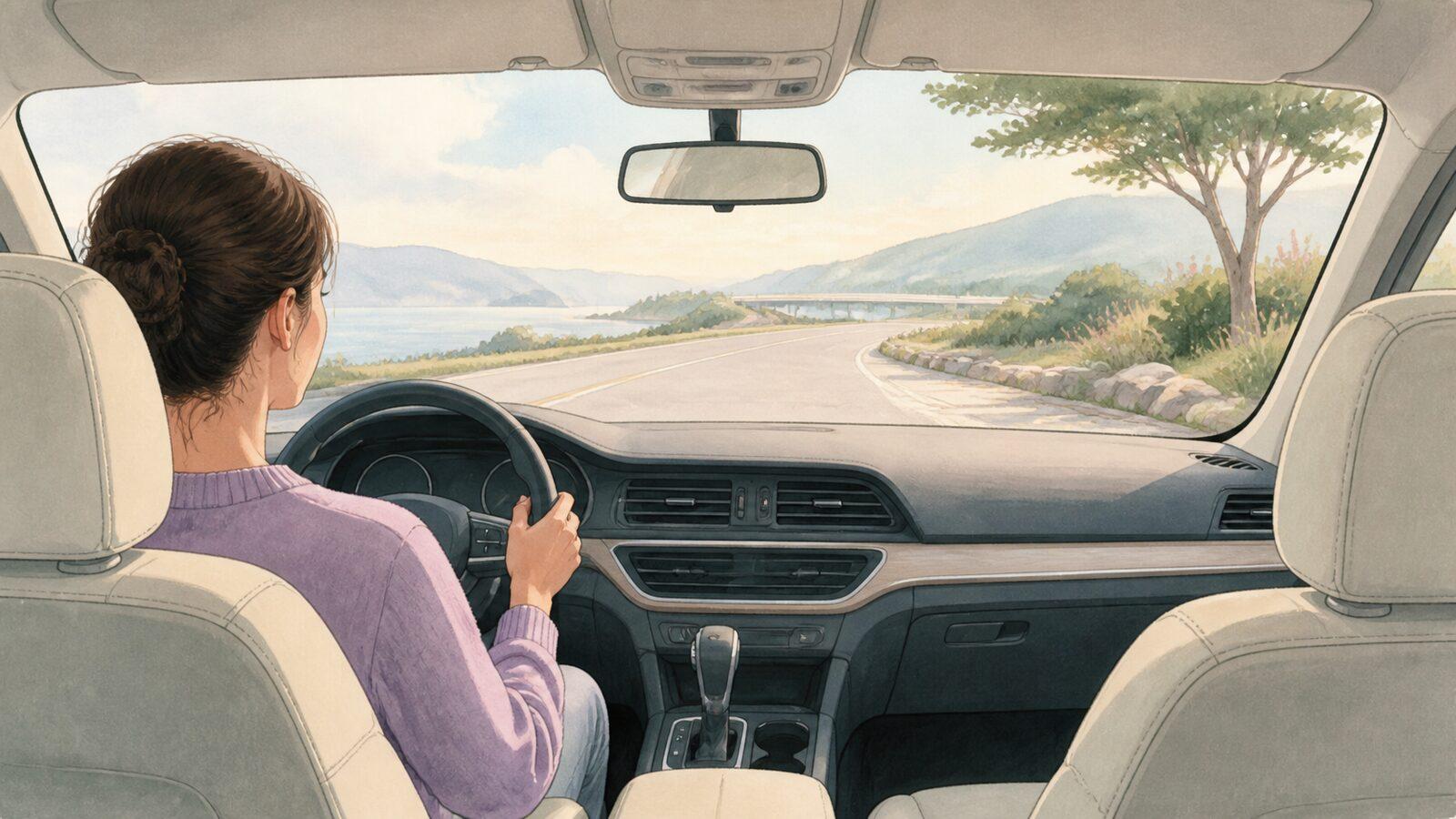
The route is ordinary until it is not. Traffic thickens, the next exit disappears behind you, and suddenly the highway feels like a trap. Your hands tighten on the wheel. Your heart races. You start watching your breathing instead of the road, and one thought takes over: What if I panic and cannot get out?
Driving anxiety can show up on highways, bridges, tunnels, unfamiliar roads, heavy traffic, or every time you drive alone. It may begin after a crash, a frightening panic episode, a long break from driving, or no obvious event. Because driving is a real safety task, the answer is neither total avoidance nor forcing yourself through a route when fear consumes the attention the road needs. It is a gradual, safety-first return that separates actual risk from anxiety's predictions.
Driving Anxiety Symptoms and Common Fears
Driving anxiety is fear or distress before or during driving that can produce panic symptoms, avoidance, or changes in driving behavior. It is a broad description, not one diagnosis. It may behave like a specific phobia or appear alongside panic disorder, agoraphobia, post-traumatic stress after a collision, generalized anxiety, or lost confidence after time away from the wheel. Research on anxious driving reflects that complexity.
The feared outcome usually falls into one or more of these groups:
- Losing control of the car: swerving, freezing, braking at the wrong moment, or causing a collision
- Losing control of your body: fainting, vomiting, becoming dizzy, or having a panic attack with nowhere to stop
- Being trapped: on a bridge, in a tunnel, in the middle lane, or far from an exit
- Being judged: holding up traffic, making a mistake, being honked at, or alarming a passenger
- Repeating a real event: another crash, near miss, breakdown, or episode of panic behind the wheel
The physical response can be intense: a racing heart, tight chest, shallow breathing, dizziness, shaking, nausea, tingling, tunnel vision, or a sense that the road looks unreal. These are familiar physical symptoms of anxiety, but behind the wheel they carry extra force because driving genuinely requires attention and coordination. The sensation is not just uncomfortable. It feels like evidence that you may no longer be safe to drive.
What Causes Driving Anxiety? Common Triggers
Driving fear is rarely distributed evenly. You may be comfortable on quiet streets and terrified on a highway. You may manage the highway until a bridge removes the option to pull over. A review of driving-related fear found that it is not limited to people who have been in crashes, and clinical research describes a wide range of situation-specific triggers.
Common ones include:
- Merging, changing lanes, or driving at higher speeds
- Bridges, tunnels, steep roads, or roads without an easy exit
- Heavy traffic, large trucks, bad weather, or night driving
- Unfamiliar routes and navigation mistakes
- Driving alone, or driving with a critical passenger
- Returning to the road after a crash, near miss, illness, or long break
- Bodily sensations that resemble a previous panic attack
The pattern of triggers can suggest what the fear is about. If bridges are difficult because you cannot leave, the core may be entrapment. If traffic is manageable alone but impossible with a certain passenger, judgment may be sharper. If the first heart flutter starts the spiral, the fear may be panic itself, a pattern explained in anxiety sensitivity.
That distinction matters. A generic instruction to "drive more" is not a plan. You need to know which situation, sensation, or prediction you are training your brain to handle.
How Avoidance Keeps the Fear Going
Avoiding one difficult road brings immediate relief, which your brain may record as proof that the highway was dangerous. The next alarm can start earlier, and the avoided category may expand from one bridge to all highways, unfamiliar routes, or driving alone. This is the reinforcement loop behind exposure therapy: short-term relief protects the feared prediction from being tested.
Safety behaviors can preserve the loop too: driving only with one particular person, gripping the wheel until your hands hurt, or repeatedly rehearsing every turn. Some preparation is sensible. Checking the weather before a mountain route is practical; refusing every dry, familiar trip unless your reassurance person is available may be anxiety setting the terms.
Do not confuse reducing anxiety-driven avoidance with ignoring real safety. Fatigue, intoxication, unsafe weather, a vehicle problem, impaired vision, or driving beyond your current skill are valid reasons not to drive. Exposure never requires breaking traffic laws, driving in conditions you cannot handle, or staying on the road when anxiety has impaired your attention.
How to Overcome Driving Anxiety With Graded Exposure
Exposure-based CBT is a well-supported treatment for specific phobias, but driving anxiety linked to trauma, panic, medical symptoms, or skill loss requires an individualized assessment. The American Psychological Association describes graded exposure as beginning with moderately difficult situations and progressing toward harder ones. The aim is repeatable practice, not throwing yourself onto the worst road and hoping.
Live-road exposure needs a strict safety gate. Do not begin active driving steps unless you are licensed, medically fit, and able to maintain attention and control. If panic has affected your control, the fear follows a crash, you experience unexplained dizziness or fainting, or your skill is uncertain, plan the work with an appropriate clinician and qualified driving instructor. A dual-control training vehicle may be the safest early setting. An ordinary licensed passenger is not a substitute for professional instruction or a vehicle they can control.
List the situations you avoid and rate the expected anxiety from 0 to 100. This highway ladder is illustrative, not a self-directed prescription. Its ratings are hypothetical, and every active-road rung must fit your health, skill, local law, and ability to drive safely:
- Sit in the parked car, set the route, and visualize the first drive: 20
- Ride as a passenger on the route in light traffic: 30
- Drive around a familiar block in daylight: 35
- Practise a quiet route with a qualified driving instructor, ideally in a dual-control vehicle: 45
- Drive the same route alone: 55
- Plan one familiar highway exit in light traffic with the instructor: 65
- Repeat that section under the instructor's safety plan: 75
- Add a longer highway section, bridge, or tunnel only when skill and attention remain reliable: 85
Your rungs will be different. If skill is part of the fear, work with a qualified instructor rather than treating a skills gap as pure anxiety.
Define success before each rung. "Feel completely calm" makes anxiety itself the test. Use a behavioral target instead: complete the planned block or take one highway exit while keeping full attention on the road. Repeat the rung on separate days until it becomes more predictable, then move up.
The NHS guide to facing fears uses the same principle: break the fear into graded situations instead of avoiding the whole category. If a rung repeatedly overwhelms your ability to drive safely, make the step smaller or do the work with a therapist or instructor. That is calibration, not failure.
Use CBT to Test the Prediction
Exposure changes behavior. CBT also makes the prediction explicit enough to test.
Before a planned practice drive, use a CBT thought record to write what you think will happen. Here is a hypothetical example:
If my heart starts racing on the highway, I will lose control of the car.
Then separate the parts:
- Situation: merging onto the highway for one exit
- Prediction: panic will make me unable to steer safely
- Expected probability: 80 percent
- Plan: light traffic, familiar route, rested and sober, qualified instructor in a dual-control vehicle
- Result recorded after parking: anxiety peaked at 65, steering stayed steady, exited as planned
The point is not positive thinking. It is accuracy. Anxiety speaks in certainty, while a written record forces it to make a measurable forecast. Repeated gaps between the forecast and the result create corrective learning that reassurance alone often does not provide.
Poor sleep, excess caffeine, rushing, an unfamiliar vehicle, or a critical passenger may raise the starting level. Tracking them keeps one hard drive from becoming evidence that all driving is impossible.
Can You Drive With Anxiety? What to Do if It Spikes
The first task is still driving. Keep your eyes on the road, your hands available for control, and your attention on traffic. Do not open AnxietyPulse, text someone, search for a breathing exercise, or use any phone feature while moving. The CDC is direct: other tasks belong before or after the trip.
If the surge is mild and you remain able to drive safely, focus on the next concrete road action: hold your lane, maintain a safe legal speed, leave space ahead, and follow signs toward a familiar exit. Do not adjust your phone, navigation, audio, or other devices while moving. If a passenger is present, they can handle navigation or controls. Do not make a sudden maneuver just to escape the feeling.
If anxiety is interfering with safe control, signal and move toward the nearest legal place of relative safety, such as an exit, service area, parking lot, or another location designed for stopping. A roadside shoulder is not automatically safe, especially on a high-speed road. Follow local road rules and use the safest available option.
Once safely parked, put the vehicle in park and give the surge time to settle. Lengthen the exhale, release your grip and shoulders, and name what is happening without arguing with it. You can use the steps in how to stop a panic attack now that your attention is no longer needed for driving. Resume only when you can again give the road your full attention. If that does not happen, arrange another way home.
New or severe symptoms should not automatically be labeled anxiety. For crushing or persistent chest pressure, fainting, severe breathing difficulty, new weakness, or new speech or vision changes, stop in the safest available legal place. Call local emergency services once stopped. Do not drive yourself to care or resume the trip. MedlinePlus advises immediate care for chest pressure with symptoms such as nausea, sweating, dizziness, or shortness of breath.
Track the Pattern While Parked
Driving anxiety can turn the worst minute into your memory of the entire trip. A short record preserves the actual sequence and helps you understand your triggers.
Use AnxietyPulse before starting the car or after you are safely parked, never while moving. Log:
- The route and road type
- Whether you were alone or with a passenger
- Traffic, weather, daylight, and familiarity
- Sleep and caffeine
- Anxiety before the trip and the remembered peak
- What you predicted and what actually happened
- Any route, reassurance, or escape behavior you used
Across several drives, the useful pattern becomes visible. Maybe the spike comes before the highway and drops after the first exit, or bridges are manageable in light traffic but not at night. That record helps you choose the next rung from evidence rather than the loudest memory.
When Professional Support Helps
Get help when driving anxiety is shrinking work, relationships, medical access, or basic independence, or when panic repeatedly interferes with safe control. A therapist trained in CBT and exposure can distinguish a specific driving fear from panic disorder, agoraphobia, or trauma after a collision, then pace the work around the actual problem.
A clinical assessment is also appropriate if dizziness, fainting, vision changes, medication effects, or another physical problem may be contributing. If confidence dropped because your skills are rusty, a qualified driving instructor may be the most direct first step. Anxiety treatment cannot substitute for competent vehicle handling, and a driving lesson cannot treat trauma or panic. Sometimes both are needed.
The Takeaway
Driving anxiety turns a route into a chain of predictions: I will panic, lose control, become trapped, or cause harm. Avoidance leaves those predictions untested, so the feared territory can expand.
The way back is specific and gradual. Identify the trigger, build a ladder that respects real road safety, practise one repeatable step at a time, and compare the forecast with the result. If anxiety spikes while the car is moving, driving gets all of your attention. Pull over only where it is safe, use coping tools once parked, and continue only when you can focus fully again.
This article is for informational purposes only and is not a substitute for professional medical advice, mental health treatment, driving instruction, or local road-safety rules. If anxiety is impairing your ability to drive safely, stop in a legal place of safety and seek appropriate professional support.