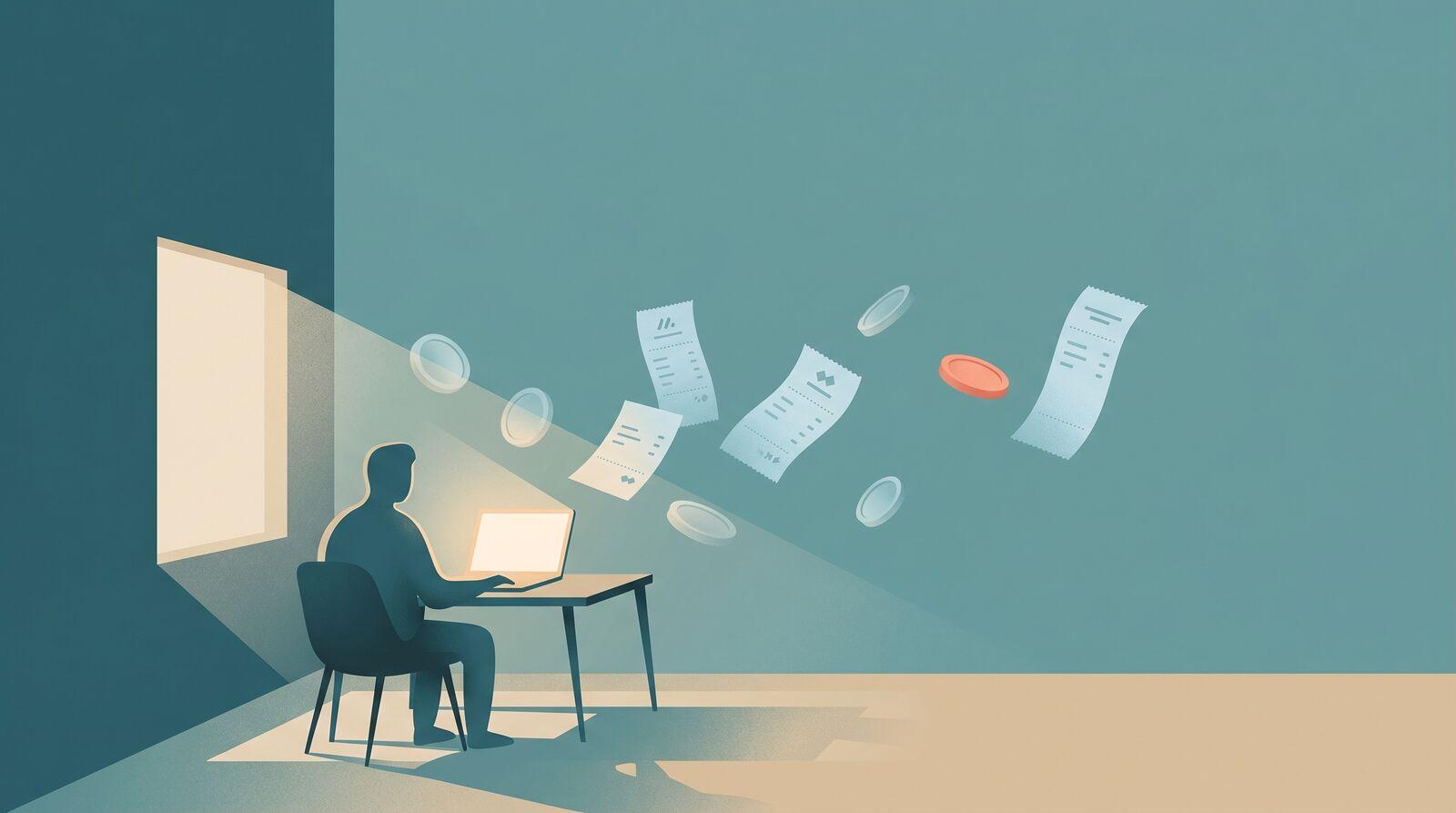
You wake up at 3am with a knot in your chest about a bill, a balance, a quote, a tax form. You haven't looked at your bank account in eleven days because looking makes it worse, and not looking also makes it worse, and you cycle between the two states without doing anything about the underlying numbers. By morning you are tired and behind, and the actual problem (which may be small, may be large, may not even exist) is now wrapped in a layer of dread that has nothing to do with the math.
This is money anxiety, and it is one of the most predictable and least talked-about features of modern adult life. It is not a sign you are bad with money, not proof that you should be earning more, and not, despite how it feels at 3am, evidence that disaster is closing in. It is your nervous system applying its physical-threat machinery to a category of threat (abstract, future, quantitative) that the machinery was not designed for, and getting stuck in a loop because the threat never resolves the way a charging predator does.
Here is what money anxiety actually is, why the stress response treats a credit card balance like a charging predator, the specific patterns that keep it alive, and a practical path out that does not require you to first fix your finances.
What Money Anxiety Actually Is
Money anxiety is the activation of the stress response by financial stimuli: bills, account balances, debt, taxes, market drops, the cost of an unexpected repair, the sound of a credit card terminal beeping in a way that might mean decline. It can occur at any income level. People with substantial savings get it about retirement and "what if everything collapses." People living paycheck to paycheck get it about rent and the next car repair. Plenty of high earners get it harder than people earning a third of what they do.
The clinical literature does not separate "money anxiety" into its own diagnosis. It shows up as a common driver of generalized anxiety, of insomnia, and of depression, and large surveys consistently put finances at or near the top of the list when adults are asked what they worry about most. Financial stress correlates strongly with elevated cortisol, with worse sleep, with worse health outcomes, and (most importantly for the loop) with worse financial decisions.
This last point is the cruelest. The anxiety that the stakes are high makes you measurably worse at the thinking the stakes require. You spend the mental energy on the dread instead of the planning, and you make the kind of avoidant, short-horizon decisions that anxious cognition reliably produces. Then the avoidant decisions worsen the actual situation, which feeds the dread, which makes the next decision worse. The loop has nothing to do with how much money you have. It has to do with how your nervous system is responding to the category of stimulus.
The Stress Response Misfiring on an Abstraction
Your stress response evolved to handle threats that were physical, immediate, and resolvable through action: run, fight, climb, hide. The whole system, cortisol surge included, is designed for a short burst that ends with either survival or not, and the body returning to baseline either way.
Financial threats break every part of that design. They are not physical, so there is nothing to run from. They are not immediate, so the surge does not end in resolution. They are quantitative and abstract, which is exactly what the limbic system is bad at; it treats "we are short three hundred dollars this month" with the same circuitry that handles "a snake is in this room," because the threat-detection layer does not natively understand the difference. And the situation persists for days or months at a time, which means cortisol does not drop back to baseline the way it would after a near-miss in traffic.
What you get is a slow-burn, chronic version of the acute stress response. Elevated cortisol over weeks instead of minutes. Sleep disruption (cortisol peaks early and wakes you). Digestion changes. Concentration problems. A persistent low-grade vigilance that scans every transaction for danger. And the catastrophic-interpretation bias that anxiety produces, applied to numbers: a small unexpected expense becomes "I cannot afford to live," a quarter-percent rate change becomes "the markets are collapsing," a routine tax form becomes "I am about to be audited." Each of these spikes is the same physiological alarm as a near-miss with a car, distributed over an afternoon.
The key insight: this happens whether or not the underlying numbers are actually dire. Money anxiety is not a financial-literacy problem. It is a nervous-system problem applied to a financial trigger. Improving your finances helps; it does not, by itself, fix the loop.
Why Money Anxiety Loops
Three specific behavioral patterns keep money anxiety alive long after the original financial worry has been examined or resolved.
Avoidance. The single most common pattern. The bank app sits there with a red badge for eleven days because opening it might confirm the dread. The credit card statement does not get opened. The tax-prep emails get marked as read without being read. Each act of avoidance produces a tiny dose of relief, which the brain learns from, which makes the next avoidance easier and the next opening harder. Meanwhile the actual numbers are usually less bad than the avoidance had imagined, and were getting worse only because of late fees and overdrafts that the avoidance produced. Avoidance is structurally identical to the reassurance-seeking pattern in health anxiety: a short relief that fuels a long entrenchment.
Compulsive checking. The mirror image, equally common in a different personality. The bank app gets opened nineteen times a day. The portfolio gets refreshed during meetings. Every transaction gets stared at. Each check produces a few seconds of relief if the number is okay, and a spike of dread if it isn't, and either way the act of checking trains the brain that this is a domain that requires constant monitoring. Compulsive checking is more visible than avoidance and tends to get pathologized faster, but it is the same loop in opposite clothing.
Financial rumination. The thinking-about-thinking loop, often at 3am. You replay the spending decision, the negotiation you didn't make, the salary you should have asked for, the investment you missed, the conversation about money that went badly. The rumination feels like problem-solving and is not; the same way general rumination feels productive and isn't. It produces no decisions and consumes the mental fuel that real planning would need. The 3am money replay is one of the most universal experiences in adult life and one of the least useful.
The Time-Discounting Trap
There is a specific cognitive distortion that money anxiety produces, and it is worth naming because it is what makes anxious decisions worse than calm ones.
Under stress, the brain compresses its time horizon. The future feels less real, the present feels louder, and decisions get pulled toward whatever resolves the immediate discomfort, even at the cost of much larger future discomfort. Behavioral economists call this hyperbolic time-discounting, and the effect is amplified by anxiety. A person calm about money will see clearly that putting an emergency on a 24-percent credit card is much worse over six months than negotiating a payment plan over a phone call they don't want to make. A person anxious about money cannot quite see that, because the immediate dread of the phone call is dominating perception and the six months feels like a fog. The result is short-term-relief decisions that compound into the larger problem the anxiety was originally warning about.
This is why "just think about it rationally" does not work in money anxiety. The rational thinking apparatus is the thing being suppressed by the stress response. The fix has to come from somewhere else.
What the Evidence Shows
The treatment research on money anxiety overlaps heavily with the broader literature on stress, generalized anxiety, and behavioral activation. The consistent findings:
- Behavioral activation outperforms insight. Across stress and anxiety research, taking small concrete actions reduces anxiety more reliably than analyzing the anxiety. Money is the cleanest case: opening the app, scheduling the call, sending the email, and looking at the actual numbers does more in five minutes than two hours of worry.
- Cognitive behavioral therapy adapted for financial worry shows benefit, with the same mechanisms that work for generalized anxiety: identifying the catastrophic interpretation, testing it against actual data, dropping the safety behaviors (avoidance and checking).
- Brief financial planning sessions reduce anxiety more than they reduce financial problems. This is striking and worth dwelling on: even when the underlying numbers do not change much, the act of seeing them, organizing them, and having a plan drops cortisol and improves sleep. The relief comes from removing the uncertainty, not from removing the problem.
- Sleep loss compounds money anxiety hard. Bad sleep reduces prefrontal function and increases threat reactivity, which makes the next day's money decisions worse. Many people are stuck not because of their finances but because the finance worry destroys the sleep that would let them think about the finances.
The recurring theme: the loop is the disease, not the bank balance. People with the same income can be in completely different relationships with money depending on whether the loop is running.
A Practical Path Out
The path runs through behavior, not analysis. Belief follows action here, not the reverse.
1. Name the Loop, Not the Number
When the spike fires, the first move is to step up a level: "this is the money-anxiety loop, not new information about my life." The loop will produce thoughts that feel like emergencies; the labeling does not make them disappear, but it puts a small gap between the spike and the impulsive action it wants to drive. This is the same defusion move that interrupts every anxious loop covered in our pieces on rumination and journaling.
2. Schedule One "Money Time" Per Week, and Protect It
Money anxiety is loudest when it lives everywhere all the time. Containing it to a specific window (one 30-minute slot per week, same day, same time) does more work than its size suggests. Inside the window you look at everything, pay what needs paying, send the email, update the spreadsheet. Outside the window, when the anxiety fires, you write the thought down for the next window and resume what you were doing. This is the financial version of "worry time," which a substantial CBT literature supports as an intervention for generalized anxiety. The discipline is in the postponement; the rest takes care of itself.
3. Open the App
Specifically and concretely. If you are an avoider, the highest-leverage action you can take is the one you have been postponing for eleven days. Open the bank app, the credit card statement, the brokerage. Look. Almost always the actual number is less catastrophic than the avoided number had become, and even when it isn't, knowing is less corrosive than not-knowing. Avoidance produces no real safety; it only produces the slow inflation of the imagined number until you cannot face it. Opening the app once does more than two weeks of worrying about opening it.
4. Make the First Action Smaller Than You Think
The catastrophizing brain wants a total restructure: an overhaul, a budget, a debt-payoff plan, a new career. None of that gets done in a state of acute anxiety. Make the first action absurdly small: one bill paid, one auto-pay set up, one cancelled subscription, one ten-minute conversation with a partner or accountant. Small actions complete; small actions produce small drops in cortisol; small drops in cortisol restore enough cognitive bandwidth for the next action. This is behavioral activation in its purest form. It is also why people who try to "finally get my finances in order" in one weekend almost always abandon the project by Tuesday.
5. Cap the Checking
If you are the other kind of money-anxious (the compulsive checker), the move is the opposite. Pick a check frequency you can defend (once a day, once a week) and hold it. Delete the app from the phone, or move it off the home screen. Each time you resist a check, you teach your nervous system the thing it cannot learn otherwise: the world keeps working when you are not monitoring the balance, and the balance did not need your gaze to behave itself.
6. Separate Income Anxiety from Investment Anxiety
These two get blended together and they have completely different mechanisms. Income anxiety (am I making enough, will the job last) is a slow-burn worry about predictability and benefits from concrete action: building a small buffer, updating the resume, having one conversation. Investment anxiety (will my retirement work out, what if the market drops) is a much longer-horizon worry that responds badly to action and well to deliberate inaction: setting an allocation, automating contributions, and looking at it less often, not more. Treating them with the same tools makes both worse.
7. Build a Small Buffer, Even a Useless One
The single most calming financial intervention for the loop is a small emergency buffer. The number is less important than its existence. Even a few hundred dollars set aside, untouchable, drops a substantial amount of background anxiety because the catastrophic chain (unexpected expense → can't cover it → cascading disaster) loses its first link. This is not financial advice about the right buffer size; it is a nervous-system observation about what kind of certainty turns the loop down. If you can do nothing else this week, opening a separate account and moving a small amount into it is unusually high-leverage for anxiety reduction per dollar.
How Tracking Helps
Money anxiety, like most anxieties, runs on a specific false prediction: this is the spike that becomes a catastrophe. Your own data is the most reliable counter, because memory will preserve the spikes and lose the resolutions every time.
With AnxietyPulse, log the spike when it hits. Rate the intensity, tag it ("money worry"), and note whether you took an action or rode it out. After a few weeks the log shows two things you cannot see from inside the loop. First, the spikes peak and fade on roughly the same timescale whether or not you check the bank app, which is the single most loop-breaking piece of evidence available. Second, the spike pattern clusters around stress, sleep loss, and the day after big expenses, far more than around any actual change in your financial position, which reframes the spike as a stress signal rather than a financial signal. For more on why this kind of measurement changes the question entirely, see our piece on benefits of tracking anxiety.
When to Get Help
Money anxiety is highly treatable, and several markers suggest it has crossed from normal-life-noise into something worth a professional eye:
- The anxiety is significantly affecting sleep, work, or relationships
- You recognize the avoidance or compulsive-checking loop and cannot interrupt it alone
- Money worry is producing panic attacks, persistent low mood, or hopelessness
- You are making decisions in the loop you later regret (impulsive purchases, panic-selling investments, opening additional credit you don't want)
- The fear is consuming hours of daily time
The most useful professional help is usually two-track: a therapist with CBT experience to address the loop, and a financial planner or counselor (look for non-profit credit counseling if cost is the worry) to address the underlying numbers. Either alone is less effective than the pair. Workplace anxiety often overlaps here when the income worry is the dominant flavor; treating both together helps.
The Bottom Line
Money anxiety is the stress response, designed for short bursts of physical threat, getting stuck in a long slow burn over an abstract one. The numbers in your account matter, but they are not what the loop is responding to; the loop is responding to uncertainty, avoidance, and the false promise that one more hour of worry will somehow change the situation. It will not. Real change comes from small actions taken inside a contained window, while the rest of the time is protected from the worry that wants to fill it.
You will not stop worrying about money entirely; almost no adult does. The fix is not zero worry. The fix is a worry that lives in a 30-minute slot once a week, ends in a small action, and lets the rest of your life resume in between. The 3am wake-up may still happen for a while. It will arrive less often, and stay less long, the more you give the loop concrete actions to feed on instead of abstract dread.
The bank balance is what it is right now. The loop, separately, can be turned down starting today.
This article is for informational purposes only and is not a substitute for professional financial, medical, or mental health advice. If money anxiety is significantly affecting your life, consider speaking with both a qualified mental health professional and a non-profit financial counselor.