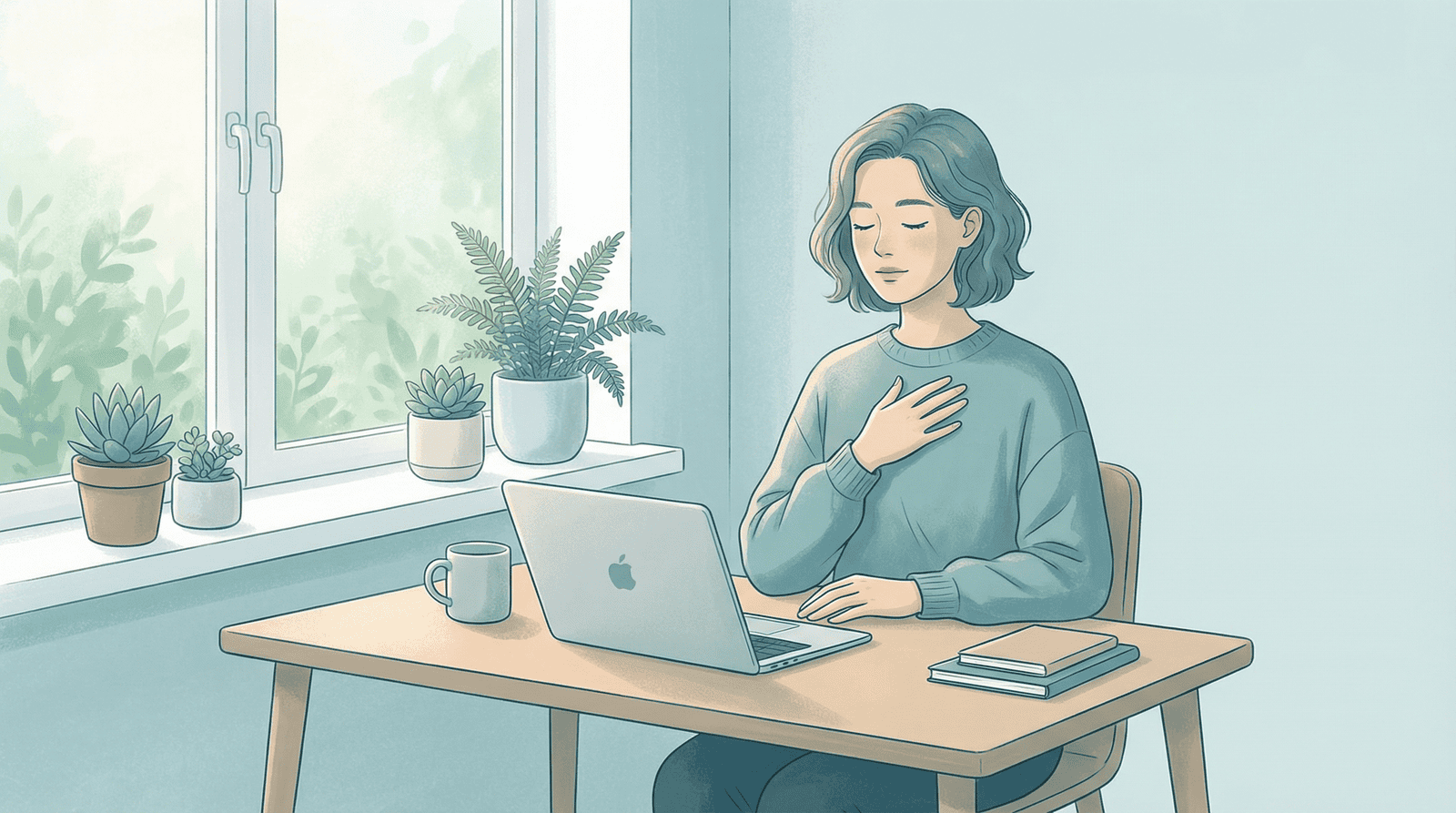
You're sitting at your desk, staring at a calendar packed with back-to-back meetings. Your inbox is overflowing. A Slack notification pops up from your manager: "Can we talk?" Your stomach drops. Your palms go damp. You haven't done anything wrong, but your body is already in full alarm mode.
If this sounds familiar, you're not alone. Research consistently shows that workplace stress is the single most common reason people seek help for anxiety, with roughly one in three therapy clients citing work as their primary trigger. The modern office, whether physical or remote, has become a breeding ground for chronic, low-grade anxiety that slowly erodes performance, relationships, and health.
The good news: you don't have to quit your job to feel better. Let's break down why work triggers anxiety and explore seven concrete strategies you can start using today.
Why Work Triggers Anxiety
Your brain doesn't distinguish between a looming deadline and a charging predator. Both activate the amygdala, flooding your system with cortisol and adrenaline. In an office setting, this response gets triggered by social evaluation (meetings, performance reviews), uncertainty (layoffs, reorganizations), and information overload (email, chat, notifications).
The problem is that these triggers rarely stop. Unlike a one-time threat, workplace stressors repeat daily, keeping your nervous system in a constant state of low-level "fight or flight." Over time, this baseline stress becomes your new normal, and you may not even realize how anxious you've become until your sleep falls apart or your patience disappears.
Understanding your specific triggers is the first step toward breaking the cycle.
The Meeting Dread Cycle
For many people, meetings are the single biggest source of workplace anxiety. The anticipation starts hours (or days) before: rehearsing what to say, imagining worst-case scenarios, worrying about being put on the spot.
This pre-meeting anxiety is a textbook example of anticipatory threat processing. Your prefrontal cortex runs simulations of everything that could go wrong, and your body responds as if those scenarios are actually happening. By the time the meeting starts, you're already exhausted.
The key insight: the anxiety before the meeting is almost always worse than the meeting itself. Recognizing this pattern is powerful, because it shifts your focus from "How do I survive the meeting?" to "How do I manage the anticipation?"
7 Strategies to Stay Calm Under Pressure
1. Time-Box Your Worry
Instead of letting anxious thoughts run all day, schedule a specific 10-minute "worry window." When a stressful thought appears outside that window, acknowledge it and tell yourself: "I'll deal with this at 2 PM." This technique, borrowed from cognitive behavioral therapy, trains your brain to compartmentalize rather than spiral.
Write down the worries as they come. When your window arrives, you'll often find that half of them have already resolved themselves.
2. Use Micro-Breaks to Reset Your Nervous System
Your body can't stay in fight-or-flight mode if you deliberately activate the parasympathetic nervous system. Every 60 to 90 minutes, take a 2-minute break:
- Stand up and stretch your arms overhead.
- Take 5 slow breaths using the box breathing technique: inhale for 4 counts, hold for 4, exhale for 4, hold for 4.
- Look at something more than 20 feet away for 20 seconds (this relaxes the muscles around your eyes, which are directly linked to your stress response).
These aren't luxury breaks. They're neurological resets that prevent cortisol from accumulating throughout the day.
3. Prepare a Pre-Meeting Ritual
Replace the dread cycle with a 3-minute ritual before any anxiety-provoking meeting:
- Ground yourself: Name 3 things you can see, 3 you can hear, and move 3 parts of your body (the 3-3-3 rule).
- Set one intention: Instead of trying to "perform perfectly," choose a single concrete goal: "I will share one idea" or "I will ask one question."
- Release the outcome: Remind yourself that your worth is not determined by this meeting.
Having a ritual replaces the chaos of anticipation with a predictable, calming sequence your brain can rely on.
4. Set Inbox Boundaries
Email and chat are open loops: every notification is a micro-demand on your attention, and each one triggers a small stress response. Multiply that by dozens of notifications per hour, and you've created a constant drip of cortisol.
Set specific times to check email (e.g., 9 AM, 12 PM, 4 PM) and turn off notifications in between. If your workplace culture demands instant responses, negotiate a compromise: keep one urgent channel open (like a direct phone call) and batch everything else.
This single change can dramatically lower your baseline anxiety within a week.
5. Adopt a "Good Enough" Mindset
Perfectionism and high-functioning anxiety are close companions. The drive to make everything flawless keeps your stress response permanently engaged, because nothing is ever truly "done."
Practice asking yourself: "Is this good enough for its purpose?" A status update email doesn't need to be a polished essay. A draft doesn't need to be final. Give yourself explicit permission to ship work at 80% when the situation calls for it.
This isn't about lowering your standards. It's about matching your effort to the actual stakes.
6. Build Movement Into Your Day
Exercise is one of the most effective anxiety interventions available, and you don't need a gym session to benefit. A 10-minute walk outside, taking stairs instead of the elevator, or doing a few stretches at your desk all help burn off excess adrenaline and trigger the release of endorphins and BDNF (brain-derived neurotrophic factor), which directly counteract anxiety.
The exercise-anxiety connection is well-established: even brief movement shifts your neurochemistry away from threat mode and toward calm focus.
7. Track Your Patterns
Anxiety often feels random, but it rarely is. When you track what triggers your workplace stress, patterns emerge: maybe Mondays are consistently harder, maybe your anxiety spikes after certain types of meetings, or maybe the 3 PM energy crash amplifies everything.
AnxietyPulse makes this easy. Log your anxiety levels throughout the workday, tag them with context (meeting, deadline, feedback, email), and review the patterns weekly. Once you see the data, you can intervene proactively instead of reacting after the fact.
When Workplace Anxiety Needs Professional Help
The strategies above work for everyday workplace stress. But if your anxiety is making it hard to function, causing you to avoid responsibilities, or manifesting as persistent physical symptoms (chest tightness, headaches, digestive issues), it may be time to talk to a professional.
Signs that workplace anxiety has crossed a threshold:
- You dread going to work most days, not just occasionally.
- You've started calling in sick to avoid specific situations.
- Sleep is consistently disrupted by work-related thoughts.
- Physical symptoms (nausea, headaches, muscle tension) have become daily.
- You've started using alcohol or other substances to cope after work.
There's no shame in seeking help. A therapist who specializes in anxiety or CBT can give you tools tailored to your specific triggers.
Your Calm is a Skill, Not a Trait
Staying calm under pressure isn't something you're born with. It's a skill you build through consistent practice. Start with one or two strategies from this list, track your progress, and adjust as you learn what works for your nervous system.
The workplace will always have deadlines, meetings, and difficult conversations. What changes is how your body and mind respond to them.
This article is for informational purposes only and is not a substitute for professional medical advice. If you're experiencing severe anxiety, please consult with a healthcare provider.