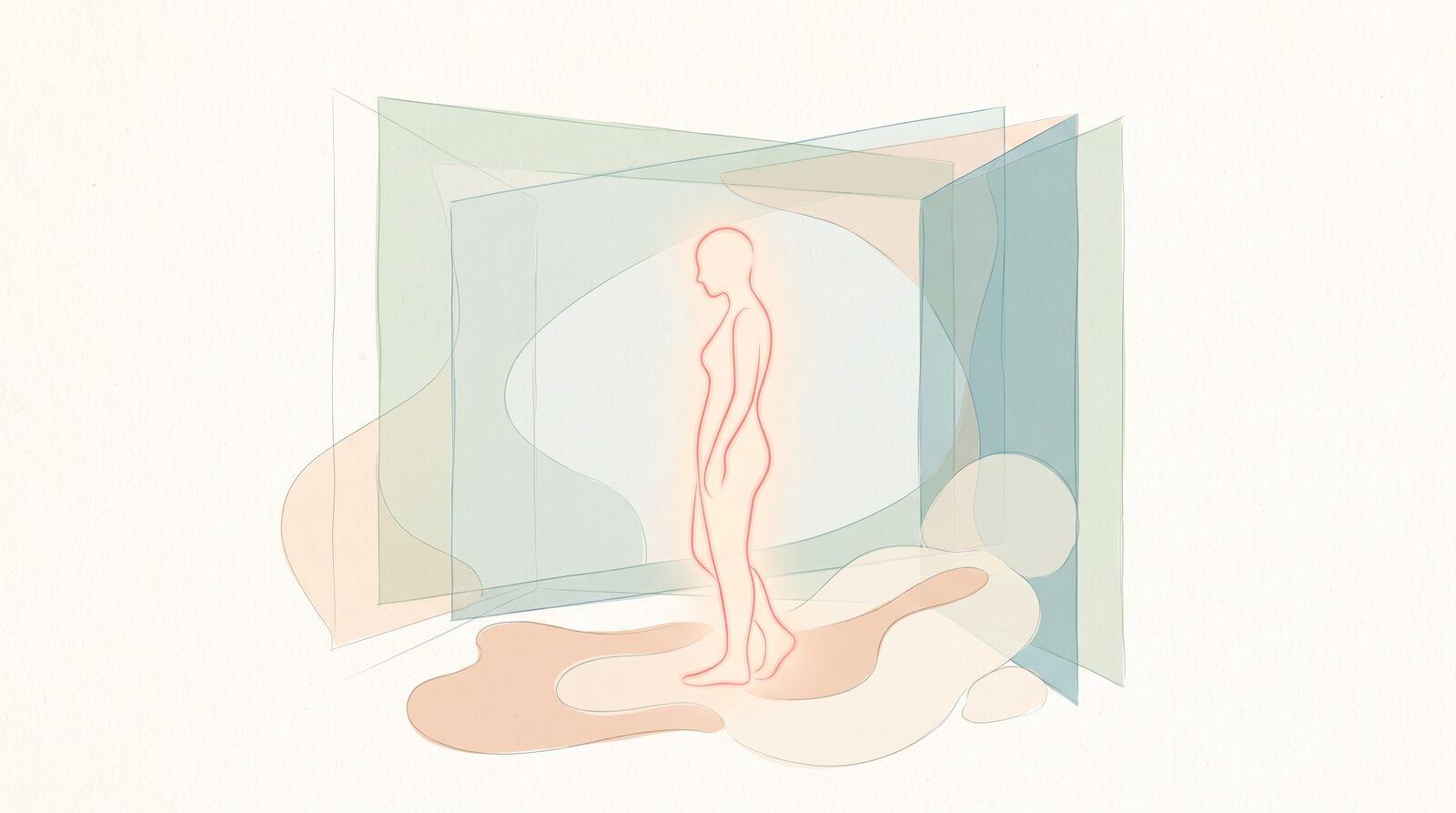
You are standing in your own kitchen and it looks like a photograph of your kitchen. Everything is where it should be. The light is normal. Your hand is on the counter and you can feel the counter. But some quality that used to make all of it real has quietly gone missing, and what is left is a very convincing set. Your voice sounds like it is arriving from the next room. You look at your hands and they seem borrowed.
Then comes the thought that makes it so much worse: something has broken. Not a passing feeling, but permanently, structurally broken. You are losing your mind, or your brain is damaged, or you are about to detach from reality entirely and never find your way back.
This is derealization, and it is one of the most frightening things anxiety does. It is also one of the most misunderstood, because it does not feel like anxiety. It feels like a neurological emergency. Almost everyone who experiences it privately concludes they are the first person it has ever happened to, and almost everyone is wrong: transient episodes of unreality are extraordinarily common, and the mechanism behind them is far more mundane than the sensation suggests.
Derealization or Depersonalization?
The two travel together and get used interchangeably, but they point at different things.
Derealization is about the world. Your surroundings look flat, foggy, dreamlike, two-dimensional, artificially bright, or oddly distant, as though you are watching them through glass or on a screen. Familiar rooms feel unfamiliar. Colors can seem washed out or too vivid. Sound arrives muffled or delayed.
Depersonalization is about you. You feel detached from your own body, thoughts, or emotions: watching yourself from a few feet behind, going through the motions on autopilot, unable to feel much of anything about people you know you love. Your reflection can seem like a stranger's.
Most people get some blend of the two. The unifying feature is a sense of unreality laid over an experience that is otherwise entirely intact. Nothing has changed about the room. What has changed is the feeling of presence that normally accompanies perceiving it.
One distinction matters more than any other, and it is the reassuring one. This is not psychosis. In psychosis, reality testing fails: the person believes the unreal thing. In derealization, reality testing is perfectly intact, which is precisely why it is so distressing. You know the kitchen is your kitchen. You know your hands are your hands. The horror comes from the gap between what you know and what you feel. That gap is the signature of dissociation, not of losing touch with reality.
Why Your Brain Does This
Derealization is not a malfunction. It is a protective response that has been switched on at the wrong moment.
When arousal climbs past a certain point, the brain has a dampening option available: it can turn down the volume on emotional and sensory processing. In genuine catastrophe, this is useful. People describe car accidents and assaults in exactly this language, time slowing, everything going quiet and remote, the event happening to someone else. The detachment buys functional calm in a situation where full emotional engagement would be paralyzing. Researchers generally understand it as a top-down braking system, with prefrontal regions clamping down on the limbic circuitry that generates emotional response.
Chronic anxiety runs that same arousal high, day after day, without any accompanying catastrophe. Eventually the braking system engages anyway. The result is a person having an ordinary Tuesday who suddenly feels like they are watching a film of an ordinary Tuesday.
Three concrete drivers do most of the work:
Hyperventilation. This is the most underrated and the most fixable. Fast, shallow, upper-chest breathing blows off carbon dioxide faster than you produce it. Low CO2 causes blood vessels in the brain to constrict, which reduces cerebral blood flow, which produces lightheadedness, visual strangeness, tingling, and a pronounced sense of unreality. It is the same chemistry behind the symptoms in our guide to shortness of breath and to dizziness. You do not have to be gasping for this to happen. Weeks of slightly-too-fast breathing is enough.
Exhaustion. Sleep deprivation reliably increases dissociative experiences even in people with no anxiety at all. If your unreality episodes cluster after short nights, that is not a coincidence, and it is the easiest lever you have.
Sustained threat load. Long stretches of stress, grief, burnout, or unrelenting vigilance keep arousal elevated until the dampening response starts triggering on its own.
Why the Fear Is What Keeps It There
Here is the part that decides whether an episode lasts ten minutes or ten months.
Derealization on its own is an uncomfortable perceptual state. What turns it into a chronic condition is the interpretation you attach to it. The cognitive model of persistent depersonalization is built almost entirely around this: the symptom is maintained not by the dissociation itself but by catastrophic appraisals of it. I am going insane. I have brain damage. This will never stop. I am not really here anymore.
Follow the loop. Each of those thoughts is a genuine threat signal, and threat signals raise arousal. Raised arousal is exactly the condition that triggers the dampening response. So the fear of unreality produces more unreality, which produces more fear. The symptom becomes its own fuel, which is the same self-sustaining engine described in our guide to anxiety sensitivity, running on perception instead of heartbeats.
Checking makes it worse in a specific way. Most people develop a habit of testing whether it is still happening: staring at their hands, examining their reflection, poking at the feeling to see how bad it is today. That kind of monitoring is not neutral observation. Attention amplifies whatever it is pointed at, and pointing it at your own sense of presence is a fast way to disturb something that normally runs without supervision. It is a bit like becoming aware of your own blinking. The scrutiny creates the problem it was checking for.
The uncomfortable but liberating implication: the way out is not to fight the sensation but to stop granting it emergency status. Episodes that get met with boredom tend to shorten. Episodes that get met with alarm tend to stay.
What Actually Helps
Correct the breathing first. If hyperventilation is contributing, nothing else will work well until it is fixed. Slow, low, nasal breathing with a long exhale, roughly four counts in and six to eight out, restores CO2 and reverses the vasoconstriction. Do it for several minutes, not several breaths, and do it daily rather than only in emergencies, because chronic over-breathing is a habit that needs retraining. A paced breathing timer like Flow Breath makes the cadence automatic so you are not counting while feeling strange.
Ground through sensation, not through thinking. Trying to reason your way back into feeling real does not work, because the problem is not in your reasoning. Physical input works better: cold water on the wrists, holding something textured, pressing your feet hard into the floor, strong flavors, naming five things you can see out loud. Our guide to grounding techniques covers the full set. The goal is not to make the feeling vanish on command. It is to give your nervous system unambiguous evidence of a body in a place.
Move. Physical activity raises arousal in a way the body reads as safe and productive rather than threatening, and it is one of the more reliable ways to break an episode. A brisk walk outside beats sitting still and monitoring.
Practice not checking. When you notice yourself testing the feeling, name it as checking and deliberately return your attention to whatever you were doing. Not as a distraction technique but as a policy: this sensation does not get monitored anymore.
Stay in the situation. The instinct is to leave, cancel, go home, lie down. Avoidance teaches your brain that unreality was genuinely dangerous and needed escaping, and the next episode arrives with more authority. Continuing the conversation while feeling strange is unpleasant and gathers exactly the evidence you need.
Address the inputs. Cut or trial-remove cannabis, which is one of the most common precipitants of persistent derealization, and be honest about caffeine, which pushes arousal in the wrong direction. Protect sleep with the tactics in our sleep hygiene guide. Long unbroken stretches of screen time can also thin the sense of presence, which our post on digital detox covers in more depth.
Finding Your Pattern
Derealization feels random, which is a large part of why it is so frightening. Something that arrives without warning and without cause is much harder to live with than something that follows rules. In practice it almost always follows rules; they are just difficult to see from inside an episode, and memory is a poor witness afterward.
This is where records change the experience. Logging episodes in AnxietyPulse, noting when unreality showed up alongside sleep, caffeine, stress, and what the day contained, usually produces a pattern within a few weeks. People commonly discover their episodes cluster after nights under six hours, or during particular recurring stressors, or in specific environments: supermarkets, motorways, fluorescent-lit offices, crowded rooms. Our guide to understanding triggers explains how to read those clusters once you have them.
The moment the symptom becomes predictable, it stops being an ambush. And a symptom that is no longer an ambush is one you are far less likely to fear, which quietly disassembles the loop keeping it alive.
When to Get Extra Support
See a professional if the unreality is near constant rather than episodic, if it has persisted for months, if it is significantly restricting your life, or if the fear surrounding it has become a daily preoccupation. Persistent depersonalization-derealization is a recognized condition and a treatable one, and the treatment with the best evidence is cognitive behavioral therapy targeting exactly the appraisals and monitoring habits described above.
It is also worth one medical conversation to rule out the small number of physical contributors, including migraine, inner-ear problems, thyroid dysfunction, seizure activity, and side effects of certain medications. Get that done once, properly, so the background question stops circulating. Note that some people develop derealization following a panic attack, in which case our guide on how to stop a panic attack addresses the event that started it.
The Takeaway
Derealization is your brain applying its emergency dampener to a situation that is not an emergency. The world looks like a set because emotional and sensory processing has been turned down, usually by some combination of over-breathing, exhaustion, and sustained threat load. It is not psychosis, it is not brain damage, and it is not the beginning of a permanent departure from reality, and the intact reality testing that makes it so distressing is itself the proof.
What keeps it around is the alarm it generates and the constant checking that alarm produces. Fix the breathing, defend your sleep, ground through your body rather than your thoughts, keep doing the thing you were doing, and stop testing whether it is still there. Track it, so the randomness resolves into a pattern. The feeling of being real is not something you have lost. It is something that runs automatically, and it comes back on its own once you stop watching it.
This article is for informational purposes only and is not a substitute for professional medical advice. Persistent or severe derealization, or unreality accompanied by memory loss, confusion, loss of consciousness, or neurological symptoms, should always be evaluated by a healthcare provider.