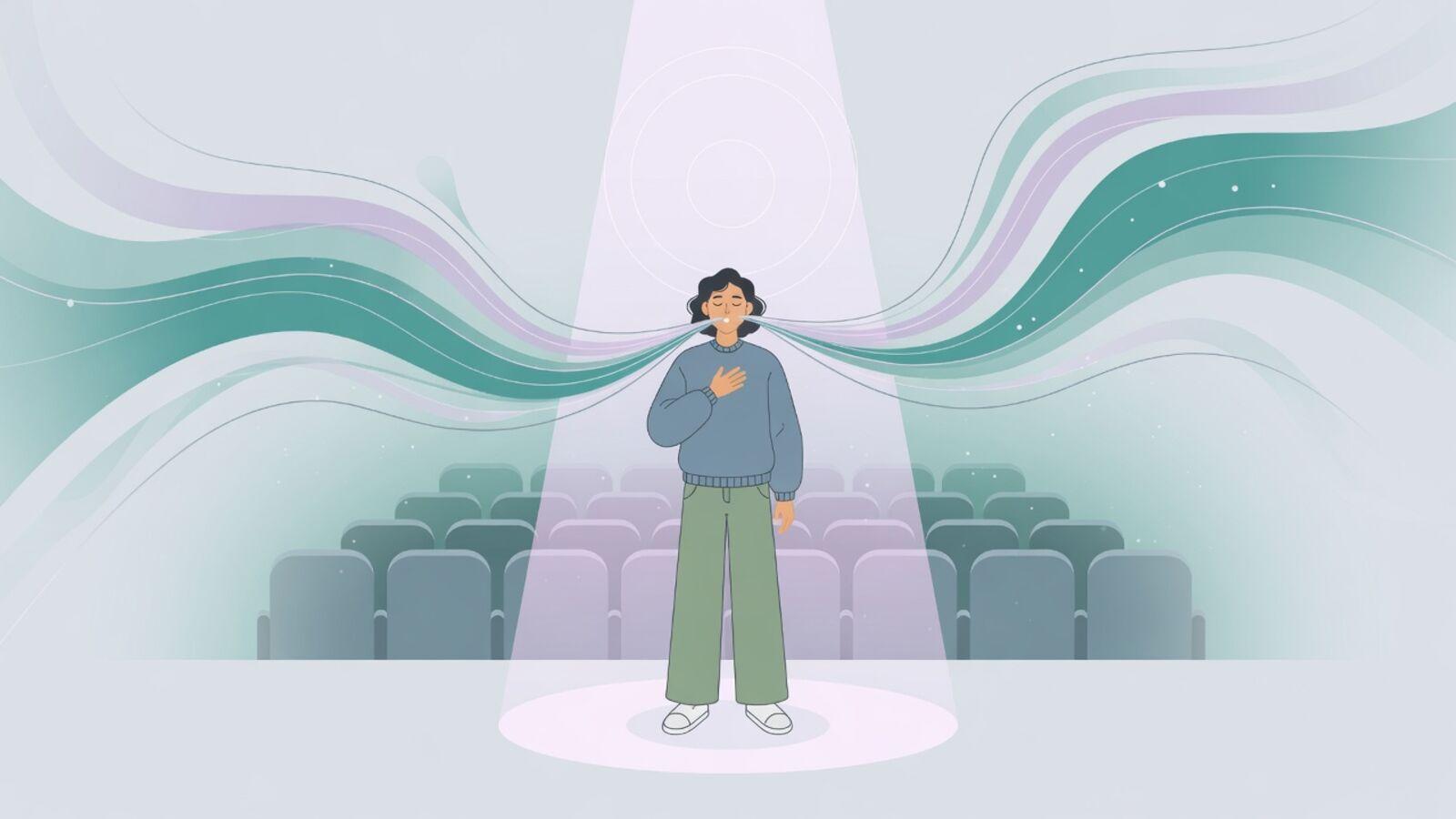
You can run the talk in the kitchen without a hitch. You know the piece. You have hit this serve a thousand times. Then the room fills, someone is watching, and the skill you own in private falls apart. Your hands shake. Your mouth goes dry. The next sentence, which you could recite in your sleep, simply is not there.
That collapse has a name: performance anxiety, often called stage fright when it hits on a stage. It is not a talent problem. It is your threat system treating evaluation as danger, then pouring so much fuel into the moment that the skill you came to use gets crowded out.
Here is what it actually is, why it shows up at the worst possible time, how it differs from social anxiety, and what interrupts the freeze without asking you to "just relax."
What Performance Anxiety Actually Is
Performance anxiety is intense fear, dread, or physical alarm before or during a task where you will be judged on how well you do it. The evaluation is the point of the situation: a presentation, a recital, a match, an exam, an interview, a pitch. Ordinary nerves sit in the same family. Performance anxiety is what happens when those nerves stop sharpening you and start interfering.
The core fear is rarely "I will be among people." It is "I will fail in front of people who are keeping score." That is why someone can be easy at a dinner table and freeze the moment they stand up to give a toast. The social part is optional. The performance part is not.
The mechanism is the same across settings: public speaking, music and theatre, sports, exams, interviews, reviews. If the situation has an audience, a score, a grade, or a yes/no outcome, it can trigger the loop.
Why the Body Panics When It Counts
A little arousal helps. Too much wrecks the thing you trained for. That inverted-U pattern is the old Yerkes-Dodson finding: moderate activation sharpens attention and energy; past a threshold it degrades precision, memory, and fine motor control. Performance anxiety is that threshold, crossed, in a room that will not wait.
The body is doing its job. Evaluation looks like a threat, so adrenaline hits: heart up, breathing high and fast, saliva gone, hands and voice sitting closer to a tremor. Those are the same physical symptoms of anxiety you might get before any scare. In a performance they have a cruel extra effect: they are visible, they land inside the skill itself, and noticing them becomes a second act you now have to hide.
Then attention turns inward. Instead of the slide, the ball, the next phrase, you monitor the shake and the thought "they can tell." Research on choking under pressure, including Sian Beilock's, describes what happens next in skilled people: the automatic process you practiced gets pulled into slow, explicit control. You try to steer a movement that usually runs itself. That is why more isolated rehearsal often fails. You do not lack the skill. You lose access to it when self-monitoring crowds it out.
What It Feels Like
The mix is physical and cognitive, and the cognitive part is what people remember as "going blank."
In the body: racing heart, shaking or a trembling voice, sweating, dry mouth, nausea, tight chest, shortness of breath, a sudden need to use the bathroom.
In the mind: racing "what if I mess this up" thoughts, a white-out where the next line should be, tunnel vision, time distortion, an urge to get it over with or leave.
In behavior: over-preparing until the night before, avoiding eye contact, reading every word off the slide, skipping the solo, calling in sick on presentation day, or white-knuckling through and then replaying every stumble for days.
None of this means the performance is actually going as badly as it feels. Spotlight bias still applies: you are tracking your own errors at high resolution, while the room is tracking the content, not your pulse. The mismatch is part of the trap. Your body is broadcasting emergency. The audience is waiting for the next sentence.
Performance Anxiety vs Social Anxiety
They overlap, and they are not the same problem.
Social anxiety is fear of everyday judgment: small talk, meetings, being seen. Performance anxiety is fear of failing a specific evaluated task. You can have one without the other. Plenty of people are fine at lunch and freeze at the lectern. Plenty of people hate parties and still play well once the music starts.
Workplace anxiety is the broader weather: inbox, deadlines, "can we talk?" Performance anxiety is the storm at the moment of delivery. Treating the weather helps. It does not automatically fix the storm. If only the evaluated moment is the problem, the work is narrower: train the skill under enough pressure that it still runs when adrenaline shows up.
What Makes the Next One Worse
Avoidance feeds it. Cancel the talk or skip the audition, and relief arrives immediately. The brain files that relief as proof the situation was dangerous. Next time the alarm is louder. That is the same engine we unpack in exposure therapy.
Safety behaviors do a quieter version of the damage: memorizing every word, refusing to look up, gripping the podium, practicing only alone. If nothing bad happens, your brain credits the crutch, not you.
Caffeine on the day of the event mimics the same adrenaline signature. If your baseline is already high, a strong coffee is a head start for the shake. See caffeine and anxiety before a high-stakes morning.
Then the post-mortem: after the event, the mind keeps only the stumbles. That recap becomes the story you carry into the next performance.
How to Interrupt It
You will not think your way into a calm body in the sixty seconds before you start. The useful moves are physical first, attentional second, and then, over weeks, exposure.
1. Relabel the surge
The sensations of anxiety and the sensations of mobilization overlap: heart up, energy up, alertness up. Telling yourself "I am in danger" pours fuel on them. Telling yourself "my body is getting ready" does not magically erase the feeling, but it stops you from treating the feeling as evidence of failure. You do not need to feel brave. You need a more accurate caption for the arousal.
2. Lengthen the exhale
Fast, high breathing is both a symptom and a cause of the shake and the blank. Make the out-breath longer than the in-breath. Two rounds of the physiological sigh (two short inhales through the nose, one long exhale through the mouth) are enough to start lowering the alarm. If you have thirty seconds in a hallway, the 3-3-3 rule gives your attention a job that is incompatible with forecasting disaster.
Do not wait to feel calm before you begin. Begin while breathing slowly. Calm follows the breath more often than the other way around.
3. Point attention at the task, not at yourself
Self-monitoring is the choke. Give the mind a concrete external target: the idea in the next sentence, the catcher's glove, the first bar of the phrase, the interviewer's question. One cue is enough. "How do I look?" and "did my voice just crack?" are not cues. They are the problem wearing a helpful face.
If the blank hits anyway, buy one breath, look at your one-line prompt, and say the next true thing. Recovering in view is a performance skill. Pretending the blank cannot happen is a safety behavior.
4. Practice with some pressure on
More isolated rehearsal trains the kitchen version of the skill. You need a few reps of the room version: standing up, someone watching, a timer running, a small chance of stumbling. That is exposure, scaled down. Record yourself. Present to one colleague. Play the piece for a friend. Take the mock exam with the same time limit. Stay long enough that the feared collapse either does not come or comes and you continue anyway.
The goal of those reps is not a calm run-through. It is a new memory: I was evaluated, I felt the surge, and the thing still got done. Drop one safety behavior per rep: one section from notes instead of a full script, or one live listener instead of the empty room.
Track the Gap Between Forecast and Reality
Performance anxiety is a forecasting error that feels like a fact. Before the event, the mind writes a vivid failure. Afterward, memory keeps the blooper reel and deletes the parts that worked. You will not catch that distortion from inside it. You catch it on paper.
Before the next talk, match, exam, or audition, log three things: how high the anxiety is, what you are sure will go wrong, and how visible you think it will be. Afterward, log what actually happened. Do this across a handful of performances in AnxietyPulse, tagged by type (presentation, sport, music, interview, test). The pattern is usually the same: the forecast was louder than the event, the shake was less obvious than it felt, and the "disaster" looked ordinary from the outside.
The record also catches setup factors memory drops: caffeine, a short night, a week of avoidance. Once those are visible, you can change them.
When Extra Support Helps
Self-help is enough for a lot of stage fright and presentation nerves. It is not the whole answer when avoidance starts shrinking your work, sport, or art: turning down talks, leaving a team, skipping juries, or needing a drink to walk on. Cognitive behavioral therapy with structured exposure is the most researched treatment for this pattern. A clinician can also check whether social anxiety or panic is riding along.
If physical symptoms during performances are new, severe, or do not track with the event, get them checked.
The Takeaway
Performance anxiety is your alarm system firing because you are about to be scored. A moderate dose helps. A flood steals the skill you already have, then convinces you that you never had it. Relabel the surge, slow the exhale, put attention on the task, and practice with a little pressure so the kitchen version and the room version start to match. Keep a record of forecast versus reality: the mind that panicked will not be a fair witness.
You do not have to love the spotlight. You have to stay in it long enough for your body to learn that evaluation is not the same thing as danger.
This article is for informational purposes only and is not a substitute for professional medical advice. If performance anxiety is shrinking your work, studies, sport, or creative life, please consult with a healthcare provider.
